-
  Sei a pag. 1  di home > templi                                               Messico 

Templi antichi del Messico


OAXACA, MEXICO
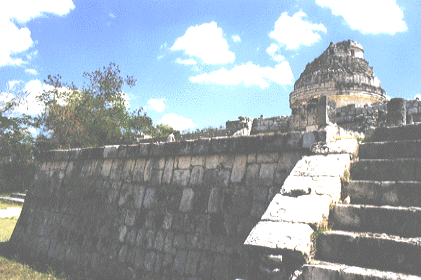
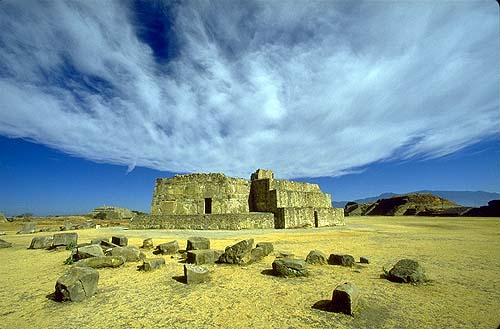
osservatorio astronomico degli Zapotechi (100 a.C.-100d.C.)

Dalla valle di Oaxaca in Messico si erge una collina sulla cui sommità  si trovano le rovine di Monte Alban.
E' questo il secondo più grande sito di cerimonie del Centroamerica dopo quello di Teotihuacan presso Mexico City.

Sono tra i resti piu' antichi del centroamerica:vi sono geroglifici che datano tra i piu' antichi.


Gli edificii originari  risalgono a 800-1000 anni a.C.ed ora sono semidistrutti o sepolti sotto ai piu' recenti.
Nel 100 a.C. il sito venne occupato dal popolo Zapoteco e le strutture che si vedono sono dell'epoca di maggior splendore del Regno Zapoteco: 300-900 d.C. Il sito era diventato il centro dei cerimoniali dell'Impero. Il complesso comprende piazze enormi, piramidi, campi per il gioco della palla,cunicoli sotterranei e 170 tombe monumentali. Il sito venne abbandonato nel 900 e divenne un sito cimiteriale dei Mixtechi.
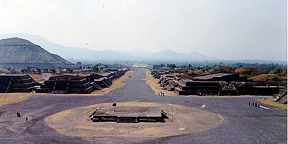
Teotihuacán , la città  degli dèi ovvero : dove gli uomini Maya diventavano dèi . Il sito comprende circa 600 piramidi di varie taglie sulle quali domina la grande Piramide del Sole.Questa piramide è costruita sopra caverne naturali.
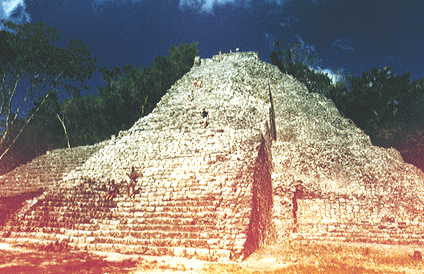
Le caverne erano considerate dai Maya come "porte" che introducevano nel mondo degli Spiriti, lo Xilalba.
Queste caverne sotterranee contengono tracce di pratiche sciamaniche più antiche.

Sei video vrml (realtà virtuale) che ricostruiscono la città Maya :  
 video1   video2    video3   video4  video   video6

Soaring above the valley and city of Oaxaca, the hilltop ruins of Monte Alban are the second largest ceremonial site in Mesoamerica, only exceeded in size by Teotihuacan near Mexico City. The ruins are extremely old; hieroglyphs found here are among the very oldest writings in all Mesoamerica. The first known buildings were constructed between 800-1000 BC but most of these are now destroyed or buried beneath later Zapotec structures. The Zapotec occupation of the site dates from 100BC and most of the enormous structures standing today date from the Classic phase of 300-900 AD when Monte Alban had become the principal ceremonial site of the Zapotec empire. The complex contains great plazas, numerous pyramids, a ball game court, underground passage ways, and over 170 tombs. The site was abandoned as a functioning ceremonial center during the 10th century though it continued to be used as a burial place by the Mixtecs. Mound J, illustrated in the photograph, has been shown to be a highly refined and complex astronomical observatory. Built sometime between 100 BC and 200 AD, Mound J has been shown to have astronomical alignments with the setting positions of the Southern Cross and Alpha and Beta Centauri, and the rising position of Capella.

In Nahuatl, Teotihuacán means The City of the Gods, or Where Men Become Gods. The plazas, avenues, and great pyramids of the city of Teotihuacán were laid out as a symbolic sacred landscape of artificial foothills and mountains . The complex of approximately 600 pyramids of various sizes is dominated by the great Pyramid of the Sun which, it was discovered in 1971, was built over a natural cave with four chambers . Mesoamerican belief saw caves as gateways to the spiritual world (called Xibalba by the Maya). The cave contained remains of offerings and may have been a focus for shamanistic rituals from a much earlier period. There can be no doubt that the Pyramid of the Sun was deliberately built over the sacred cave.       Both the idea of the cave and the artificial mountain constructed over it (or containing it) is also seen among the Ancient Egyptians in the pyramids at Giza.

The Mayan Temples that we will be discussing and displaying refer to Monolithic and Megalithic Art. Some of the things that will be discussed are: Mayan Carvings, Temple ruins of the late Mayan and questions such as Who are the Mayans? How did the Maya build their temples? Why did they build the temples? When did they build the temples? and Where these Mayan Temples are located. Some that will be displayed are: The Tulum Temple, and the Castle of Tulum and Chichen Itza.
Most Mayan carvings were found in ruins. One carving was a human figure adorned with headdresses and jewelry, which suggested high rank in Mayan society. Temple ruins are very few in number, but one of the ruins shows evidence that the Maya decorated their buildings profusely and with intense meaning. By the tenth century most Mayans had migrated to the north to the Yucatan Peninsula, leaving their remarkable cities behind. After the migration to the north, elaborate cities were built in Chichen-Itza and Uxmal, where some of these Mayan remains still exist. Answers to whether these ruins are monolithic or megalithic are quite simple. Monolithic is a large single rock that has carvings and designs, the Mayans used this technique frequently. Megalithic constructions were made of huge stones, these were used to build the Mayan temples. The Mayans built their temples using the few giant rocks they could find.The answer as to why Mayans built these temples is pretty easy to answer. They built these temples in honor of their gods and mainly were for religious aspects. The Maya built these temples around the 1400's , but their isn't a specific date on which they built. Most Mayans and their temples are located in Southern Mexico. Two well known places where these temples are located are Guatemala, and Honduras.Some of the tools that the Mayans used were made from volcanic glass and other objects that were shot out from volcanoes. Maya still use the traditional basalt mano and metate for grinding Maize and other foods. Their homeland was approximately 125,000 square miles. Rainstorms have damaged lands of Guatemala and have produced a landscape of clay ravines, between hogback ridges, and valleys. Most temples they built have brought settlers there for more than 3,000 years.
Having learned about the Mayan cultures and their temples, we now know how they did their work and how they built their temples, what tools they used and where these temples are located. 
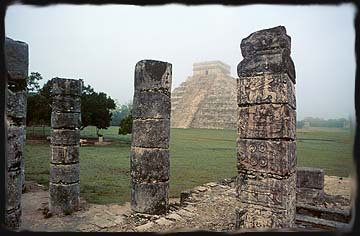
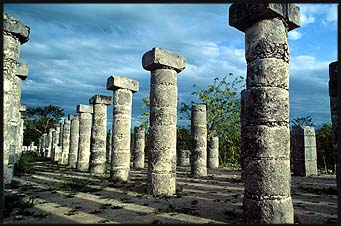
The Temple of the Warriors
The Temple of the Warriors and it's adjacent Temple of the Jaguar are the most awe inspiring ruins on the complex. A massive temple structure, surrounded by hundreds of columns is carved with reliefs. Still early morning I wandered into the rows of columns with the sun just breaking through.


  Sei a pag. 1  di home > templi                                               Messico 


-